Timing Built the Drive Thru. Nitro Vision AI Moves It Forward.
By Eliza Miller • October 9, 2026 • 5 minute read
A timer tells you how long a car took. It can't tell you why. Nitro Vision AI follows each vehicle through the whole lane, so crews can see what's slowing things down while there's still time to fix it.
Share
For decades, timing told us how fast the lane ran. The connected drive thru is asking a harder question, and answering it is the next chapter for HME.
What is Nitro Vision AI? Nitro Vision AI is HME’s camera-based intelligence layer for the drive thru. It builds upon the ZOOM Nitro® Timer to follow each vehicle through the customer journey and turn what’s happening in the lane into information crews can act on in the moment.
For most of the drive thru’s history, one question mattered above all others: is the car at the window, and how long did it take to get there? The ground loop answered it, and it answered it well. HME introduced the first drive thru timer in 1990, and loop-based timing gave restaurants an accurate, reliable performance signal for the operation they were running.
That operation has changed.
Mobile ordering, delivery, and a growing list of fulfillment paths have made the drive thru a more dynamic place. The 26th Annual Intouch Insight Drive Thru Study (2026) shows the shift. Compared with 2018, the average line is 37% shorter, yet the average visit takes 8% longer, at 5 minutes and 24 seconds. Fewer cars are waiting, but the time is going somewhere else in the journey.
Demand shifts quickly across channels, and a quiet lane can turn into a micro-rush in minutes. Arrival-to-exit time is still the foundation. But two stores with the same average time can have completely different days, which is why it’s more important than ever to understand what’s happening across the operation. Total visibility is what gives operators the context to improve every stage of the customer journey.
The harder question is why. When the line backs up, is it a large order, order-taking, or staffing? When a car pulls away, what did it cost, and could anyone have seen it coming? Those answers do not live in a single timing number. They live in the context around it: the queue, the flow, and the whole journey a vehicle takes through the lane. Context is what gives a number meaning.
So we built the layer that sees it.
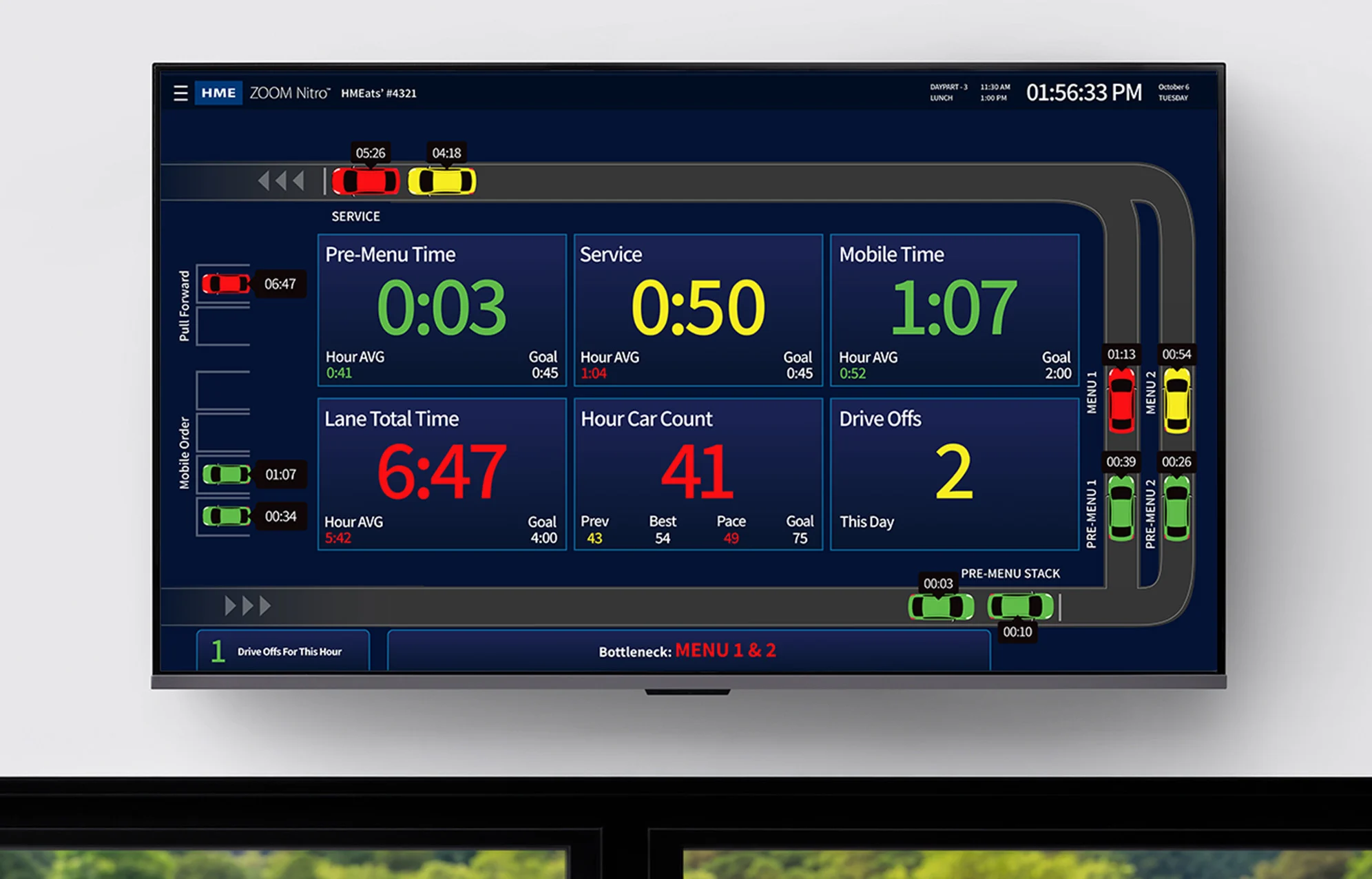
Nitro Vision AI builds upon the ZOOM Nitro Timer, using camera-first vision to recognize each vehicle by characteristics such as type and color and follow it through every stage of the customer journey, from the pre-menu stack through the pickup window and beyond, including pull-forward spaces and mobile order pickup. It weighs signals such as arrival rate, queue depth, and dwell time to surface the primary constraint on speed of service.
Information the Crew Can Act on in the Moment
Seeing more of the lane is not the point. A dashboard full of activity does not run a better shift. The value shows up while the shift is still in play, when the right person knows what needs attention and has time to respond. That is where Nitro Vision AI is built to work: turning what is happening in the lane into information the crew can act on in the moment.
It starts with signals ZOOM Nitro operators already rely on. The bottleneck tracker shows where the lane is slowing down. Pre-menu threshold alerts flag a queue building at the menu board before it backs up the rest of the lane. Drive-off alerts call out when a guest leaves the line, so managers can see where and when it is happening. And POS integration shows transaction details so crews can spot large orders and keep the line moving. Nitro Vision AI adds context to each of those signals, so the team has what it needs to make the best call while the car is still in the lane.
A Number the Crew Can Believe
Any measurement system is only as useful as the trust the team places in it. Nitro Vision AI gives every car one identity, which helps keep the ghost cars and false completions that erode confidence in a number out of the data. And it was designed to watch the lane, not the people in it, with no license plate recognition and no biometric tracking. It works for the crew, not against them, which is what turns a good number into one a team will actually use.
Built on the Timer Operators Already Trust
We are not here to tell you the loop is finished. Plenty of restaurants will keep running loops, for good reasons, and Nitro Vision AI builds upon the timing they already trust. The loop answered the question the drive thru used to ask. We built it. Now we are building what comes next.
As restaurant technology becomes more connected, Nitro Vision AI is designed to grow with each restaurant and evolve as vision AI technology advances, with connections to other restaurant systems adding richer context as integrations mature.
As the drive thru evolves, HME evolves how restaurants understand and respond to it. That is the work, and Nitro Vision AI is the next chapter of it.
Stay ahead of the rush. To see Nitro Vision AI in your own lanes, request a demonstration here.
Share
Eliza Miller
Digital Marketing Strategist, HME